

Medical consultation: Nguyen Viet Hung, MD, MSc, Department of Ophthalmology, Hong Ngoc Phuc Truong Minh General Hospital
Several at-home eye care methods can help ease eye strain and dryness and improve blurred vision caused by certain factors. However, they cannot replace correcting refractive errors or treating eye diseases. To improve eyesight and make the eyes feel brighter, it is important first to identify what is causing blurred vision, eye strain or discomfort. This article compiles eye care tips by condition, age group and warning signs that call for a medical check-up, with consultation from Dr. Nguyen Viet Hung.
Key points:
- Easing eye strain at work: The 20-20-20 rule, deliberate blinking and near-far focusing exercises help relax the eyes and reduce dryness and irritation.
- Exercises do not reduce prescription strength: Blurred vision caused by myopia, hyperopia, astigmatism or presbyopia requires properly prescribed glasses or medical intervention.
- Eating for brighter eyes: Dark leafy greens, fatty fish and orange and red fruits and vegetables supply vitamin A, lutein and omega-3 fatty acids for the eyes.
- Eye-protecting habits: Get enough sleep, wear UV-blocking sunglasses and quit smoking. Children should spend at least two hours outdoors every day.
- See a doctor immediately if you experience sudden blurred vision, a painful red eye, flashes of light or partial loss of vision.
1. How to improve eyesight for different eye conditions
Blurred vision or eye discomfort can come from many different causes, and each cause calls for its own approach. You can compare the signs below to choose suitable eye care, and to know when self-care at home is no longer enough.
1.1. Tired eyes and blurred vision after hours at the computer: five eye exercises
Signs: Eyes feel heavy and stinging, and text gradually blurs toward the end of the day. You may also have a headache around the forehead or tension in the neck and shoulders. Symptoms usually ease after rest.
Common cause: This is a sign of computer vision syndrome (digital eye strain). When you look at something up close for a long time, the accommodative muscles inside the eye have to stay contracted for hours, while the blink rate drops sharply, leaving the eye surface dry.
Care: The exercises below help relax the eye muscles and re-moisturize the ocular surface.
Exercise 1: Follow the 20-20-20 rule
Constant near focus keeps the eye muscles tense, leading to eye strain and blurred vision. Looking into the distance is a natural and very effective way to let the eye muscles relax fully [1].
How to do it: After every 20 minutes of screen time, look at something about 6 meters (20 feet) away for 20 seconds. Note: Do not switch to looking at your phone screen during this break [1].
Scientific evidence: A 2023 study used software to remind computer users to rest their eyes under the 20-20-20 rule. It found that symptoms of eye strain and dry eye decreased with regular use, but the benefit disappeared about one week after the reminders stopped [5]. The rule therefore needs to become a daily habit to work.

Exercise 2: Blink deliberately to reduce dry eyes
When you focus on a screen, your natural blink rate drops from 15-20 times per minute to just 5-7. This makes the tear film evaporate quickly, leaving the eyes dry, stinging, gritty and blurry [2].
How to do it: Squeeze both eyes shut for two seconds, then open them wide and relax for two seconds. Repeat 10-15 times to stimulate natural tear production and spread moisture evenly across the ocular surface [2].
Exercise 3: Focus-shifting exercise (near and far)
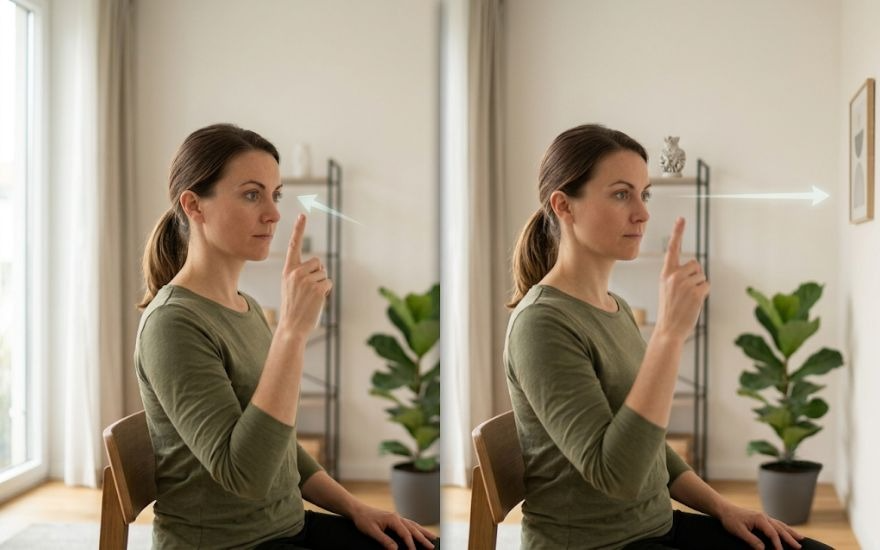
Focus-shifting exercises make the eyes alternate between near and far focus, which helps ease eye strain after long periods of close-up work [4].
How to do it: Hold your index finger about 15 centimeters (6 inches) from your nose and focus on the fingertip. Then shift your gaze to an object about 3-5 meters (10-16 feet) away, hold for a few seconds, then look back at your fingertip. Repeat this back-and-forth about 10 times [4].
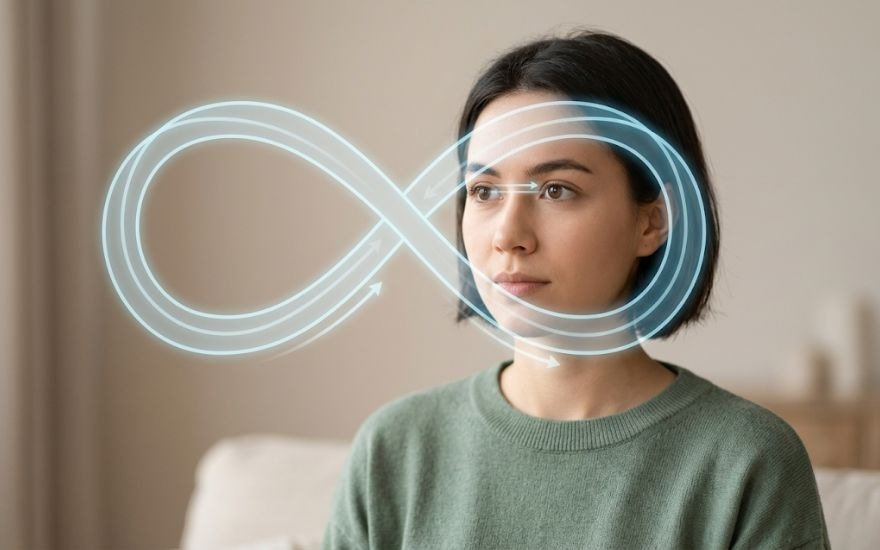
Exercise 4: Figure-eight eye exercise
The figure-eight eye exercise helps keep the muscles around the eyeball flexible through eye movements in many different directions [3].
How to do it: Imagine a giant figure eight lying on its side on a wall about 3 meters (10 feet) away. Keeping your head still, use only your eyes to trace the outline of the figure eight for two minutes, then reverse direction [3].
Exercise 5: Palming (warming the palms)
Rub your palms together for about 10-15 seconds until they are warm, then gently cup them over your closed eyes without pressing on the eyeballs. Breathe slowly and hold for 30 seconds to one minute. The darkness and warmth help the eyes relax and ease strain in the middle of the workday.
Limits of effectiveness: These exercises only relieve eye strain temporarily and do not change nearsightedness, farsightedness or astigmatism. The American Academy of Ophthalmology (AAO) says there is no scientific evidence that any eye training program can reduce or eliminate the need for glasses [6]. If your vision stays blurry after resting, or you often get headaches when reading, get a refraction test, because you may have an uncorrected refractive error.
1.2. Dry, gritty or burning eyes
Signs: Eyes feel gritty, as if there is sand in them, and burn. They may be slightly red and sometimes tear heavily as a reflex. Vision may blur briefly, then clear after you blink.
Common causes: Blinking less while looking at screens, sitting for long periods in air-conditioned rooms, wearing contact lenses for many hours, meibomian gland dysfunction (problems with the oil glands along the eyelid margins), age (especially in postmenopausal women) or side effects of certain medications.
Method 6: Warm eyelid compress. Soak a clean cloth in warm water (comfortably warm, not scalding), wring it out and place it over your eyelids for about 10 minutes, once or twice a day. Rewarm the cloth when it cools. The heat softens oils clogged in the eyelid glands, helping the tear film retain moisture longer. The international consensus report on dry eye, TFOS DEWS II (2017), lists warm compresses as a first-line treatment for dry eye caused by meibomian gland dysfunction. To melt the oils, the eyelid temperature needs to reach about 40 degrees Celsius [7]. Combine this with deliberate blinking (Exercise 2), keep fans and air conditioners from blowing directly on your face and drink enough water. You can use preservative-free artificial tears as directed by a doctor or pharmacist.
Limits of effectiveness: Do not use eye drops containing corticosteroids or antibiotics on your own. See a doctor if dry eye lasts more than two weeks despite self-care, or comes with pain, light sensitivity or blurred vision that does not improve with blinking.
1.3. Difficulty seeing clearly at a distance or up close
Signs: Squinting to read a board or road sign. Children often sit close to the TV or tilt their heads to look at things. After age 40, you have to hold books and newspapers at arm’s length to read. Text looks blurry or has a shadow at every distance (common with astigmatism).
Common causes: Mostly refractive errors, including myopia, hyperopia and astigmatism. Light does not focus correctly on the retina because the length of the eyeball or the curvature of the cornea is not normal. From around age 40, the cause is often presbyopia, when the lens gradually loses elasticity and the eyes struggle to focus up close.
Care: The most effective approach is a refraction test and properly prescribed glasses (see section 4.1). For children whose myopia is getting worse, a doctor may prescribe myopia control measures. These include orthokeratology (Ortho-K) lenses, which slowed eyeball elongation by 43% compared with eyeglasses in a two-year trial [8]; specialized lenses; or low-dose atropine eye drops, with the group using 0.05% atropine progressing by an average of only 0.27 diopters after one year, compared with 0.81 diopters in the placebo group [9]. These are combined with more time outdoors (section 2.1). Adults whose prescription has stabilized may consider refractive surgery (section 5.3).
Limits of effectiveness: Eye exercises, diet and supplements do not reduce myopia, hyperopia or astigmatism because they cannot change the structure of the eyeball. According to the AAO, these conditions come from the shape of the eye, not from weak eye muscles, so exercise cannot correct them [6]. Be cautious of ads promising to “cure nearsightedness naturally.”
1.4. Vision that gradually worsens over time
Signs: Vision seems to be seen through a haze. Car headlights glare at night and colors look faded. Straight lines look bent, and there is a blurry patch in the center of your vision. Peripheral vision narrows gradually without pain. People with diabetes may see dark spots, or their vision may come and go.
Common causes: Usually related to eye diseases such as cataracts, macular degeneration, glaucoma, or retinopathy caused by diabetes or high blood pressure. The risk increases with age.
Care: A healthy diet, quitting smoking and wearing UV-blocking glasses can lower the risk and slow progression, but they do not cure these diseases. Early detection matters most: damage from glaucoma cannot be reversed, while cataracts can be removed surgically to restore vision.
Limits of effectiveness: There is no way to improve these conditions on your own at home. If you notice the signs above, see a doctor early (see section 5).
2. Eye care for different groups of people
Each age and health condition carries its own eye risks, so eye care needs to be adjusted accordingly.
2.1. School and university students
Students spend long hours looking at things up close while studying and using their phones, and spend little time outdoors. This group has the highest risk of developing myopia and of seeing it worsen quickly.
Method 7: Spend at least two hours outdoors every day. Natural light outdoors is many times stronger than indoor light and is believed to help slow the elongation of the eyeball, the main cause of myopia. A trial of more than 1,900 first-grade students in Guangzhou, China, found that adding just 40 minutes of outdoor activity at school each day reduced the share of children who developed myopia after three years from 39.5% to 30.4% [10]. The time can be split across recess, walks or sports. Children do not need to look at the sky. They only need to be active outdoors, and should wear a hat when it is sunny.
Parents should also limit recreational screen time (the WHO recommends no screen time for children under 2 and no more than one hour a day for children aged 2 to 4 [11]), remind children to follow the 20-20-20 rule while studying, keep books 30-40 centimeters (12-16 inches) from the eyes and make sure children study at a well-lit desk. Children should have an eye exam before starting first grade and every 6-12 months after that. Children who already have myopia should be examined every six months.
2.2. Middle-aged and older adults
From around age 40, most people begin to develop presbyopia. The risk of cataracts, glaucoma and macular degeneration also rises with age.
Care: Use properly prescribed reading glasses or multifocal lenses. Avoid long-term use of ready-made reading glasses, especially if the two eyes have different prescriptions or you have astigmatism. Increase lighting when reading or doing detailed work. Have a comprehensive eye exam at age 40, then return on the schedule your doctor sets. From age 65, get an exam every one to two years. People with a family history of glaucoma should be examined earlier. Also keep blood pressure, blood sugar and blood lipids stable, as these directly affect the blood vessels that supply the eyes.
2.3. People with diabetes or high blood pressure
Prolonged high blood sugar damages the small blood vessels in the retina and causes diabetic retinopathy, which often has no symptoms in its early stages. High blood pressure can cause hypertensive retinopathy and raises the risk of retinal vessel occlusion.
Care: Keep blood sugar and blood pressure within the targets your doctor sets and take medication regularly. The DCCT trial in people with type 1 diabetes found that intensive blood sugar control reduced the risk of developing retinopathy by 76% [12]. Get a dilated eye exam at least once a year, even if your vision is still clear. Women with diabetes who become pregnant should have an eye exam early and be monitored more closely. See a doctor right away if your vision suddenly blurs, you see dark spots or your vision comes and goes.
3. What to eat for brighter eyes and lasting vision
No food can reduce myopia or cure eye diseases. However, a diet with enough nutrients helps protect the retina, keep the eye surface moist and slow the aging of the eyes.
3.1. Foods rich in vitamin A
Method 8: Vitamin A is an essential nutrient that helps the eyes see in low light and prevents night blindness and dryness of the cornea.
Recommended food sources: Red and orange fruits and vegetables such as carrots, pumpkin, sweet potatoes, papaya and gac fruit.
3.2. Foods containing lutein and zeaxanthin
Method 9: Lutein and zeaxanthin are concentrated mainly in the macula, the part of the retina that receives central images. The pair acts like “natural sunglasses,” absorbing and filtering out some harmful blue light and protecting the eyes from early degeneration.
Recommended food sources: Dark leafy greens (kale, spinach, broccoli), egg yolks and corn.

3.3. Foods that provide omega-3 and other essential nutrients
Method 10: Omega-3 fatty acids (especially DHA and EPA) are part of the retina’s structure and help the eyelid glands produce the oil layer the tear film needs. Eating fatty fish regularly is therefore part of a diet that is good for the eyes. However, it is important to distinguish between eating fish and taking fish oil supplements. The DREAM trial (2018), which involved 535 people with moderate to severe dry eye, found that taking 3 grams of omega-3 daily for one year did not improve symptoms any more than a placebo [14].
Recommended food sources: Fatty fish (salmon, mackerel, herring) two to three times a week; or chia seeds, flaxseeds and walnuts for vegetarians.

Besides omega-3, the eyes need the following nutrients:
- Vitamin C and vitamin E: These antioxidants help protect eye cells from harmful agents and slow age-related aging of the eyes. Vitamin C is abundant in citrus fruits, guava, bell peppers and strawberries. Vitamin E is found in avocados, almonds, sunflower seeds and vegetable oils.
- Zinc: Helps transport vitamin A from the liver to the retina and helps protect the eye’s visual cells. Zinc is abundant in oysters, beef, chicken, pumpkin seeds and legumes.

3.4. Should you take vitamins or supplements for your eyes?
For healthy people, a varied diet usually provides enough nutrients for the eyes. Large studies on nutrition for the eyes (AREDS and AREDS2, from the U.S. National Eye Institute) found that a supplement formula of vitamins C and E, zinc, copper, lutein and zeaxanthin benefits only people who already have intermediate or more advanced macular degeneration, helping slow the disease’s progression [13]. The formula does not help prevent cataracts or reduce myopia.
Vitamin A is fat-soluble and accumulates in the body. Prolonged high doses can cause toxicity, and pregnant women should be especially careful. Current or former smokers should not take products containing high doses of beta-carotene. In AREDS2, the lung cancer rate was 2.0% in the group taking beta-carotene versus 0.9% in the group not taking it, mainly among former smokers [13]. Fish oil capsules should also not be regarded as a treatment for dry eye [14]. Talk to your doctor before taking any supplement, especially if you are being treated for a chronic condition.
4. Daily habits that protect your vision
4.1. Wear properly prescribed glasses and use contact lenses safely
Method 11: Incorrect or outdated glasses force the eyes to focus constantly, causing eye strain and headaches. In children, refractive errors that are not corrected in time can lead to amblyopia (lazy eye). The belief that “wearing glasses weakens the eyes and makes the prescription rise faster” is incorrect, because myopia increases mainly because the eyes are still developing and because of close-up habits. In fact, a Cochrane review found that children who wore glasses weaker than their true prescription saw their myopia progress slightly more than children who wore their full prescription [15]. Children should have their prescription rechecked every 6-12 months, and adults every one to two years or as soon as their glasses no longer give clear vision. Get glasses made at a place that performs a full refraction exam.
If you wear contact lenses, wash your hands before putting them in or taking them out. Do not sleep in them (except for types prescribed by a doctor, such as Ortho-K). Do not rinse or soak lenses in tap water, and do not wear them when swimming. Use fresh solution each time, replace lenses on schedule and do not use lenses of unknown origin. An Australian survey found that the risk of infectious keratitis among people who wear contact lenses overnight is about 10 times higher than among users of daily disposable lenses (19.5-25.4 versus 2.0 cases per 10,000 people per year) [16]. Take out your lenses and see a doctor right away if your eyes become red, painful or watery, or sensitive to light.
4.2. Adjust lighting and working distance
Method 12: A poorly set up workspace is a silent cause of tired eyes. You can adjust your workstation to the standards below, based on recommendations from the American Optometric Association (AOA): keep the screen about 50-70 centimeters (20-28 inches) from your eyes and about 15-20 degrees below eye level [17].
Factor to adjust | Suggested standard | Benefit for the eyes |
| Screen viewing distance | 50-70 cm (about an arm’s length) | Eyes see clearly without straining to focus |
| Screen height | Place the center of the screen 10-15 cm below eye level | Eyelids stay naturally half-closed, reducing dry eye |
| Room and screen brightness | Match screen brightness to the room’s lighting | Prevents the pupils from constantly contracting and dilating, which causes headaches and eye strain |
| Glare control | Avoid lamps or windows shining directly onto the screen | Eliminates reflections that cause glare |
4.3. Get enough sleep and limit screen time before bed
Method 13: During sleep, the eyes pause the high-intensity focusing work they do all day, and the ocular surface is continuously moistened. Chronic sleep deprivation makes the eyes prone to dryness and stinging, eyelid twitching, temporary blurred vision and fatigue the next day. Adults should get 7-9 hours of sleep a night. If you work night shifts, schedule short breaks so your eyes do not become overloaded.
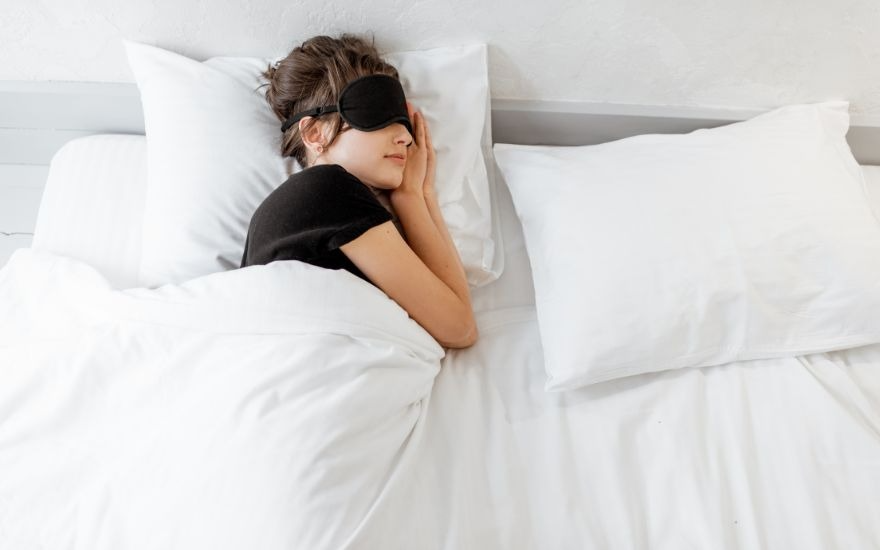
Blue light from phone screens in the dark suppresses the brain’s release of melatonin (a hormone that regulates sleep), making it harder to fall asleep, disrupting sleep and leaving the eyes dry and sluggish on waking. In one study, people who read on a tablet for four hours before bed had delayed melatonin release, took nearly 10 minutes longer to fall asleep and were less alert the next morning than when they read a printed book [18]. Stop using phones and computers 30-60 minutes before bed, and read a printed book or listen to soft music instead.

4.4. Protect your eyes from sunlight and UV rays
Method 14: UV rays in sunlight accumulate over the years, raising the risk of cataracts and pterygium (surfer’s eye) and possibly contributing to macular degeneration [20]. When you go outside, choose sunglasses that block 99-100% of UVA and UVB rays (usually labeled UV400). The darkness of the lenses does not determine UV protection, and wraparound frames limit rays entering from the sides. Also wear a wide-brimmed hat. UV rays are still present on cloudy days, and sunlight reflected off water or sand also harms the eyes. Children need the same protection as adults. Never look directly at the sun, even during a solar eclipse.
4.5. Quit smoking
Method 15: Toxic chemicals in cigarette smoke damage the tiny blood vessels that nourish the retina and speed up the aging of the eyes. Smokers have a two to four times higher risk of macular degeneration than people who have never smoked [19], and the risk of cataracts also rises markedly, especially among current smokers [21]. Direct exposure to smoke also makes the eyes drier and more severely irritated.
5. When should you see an eye doctor?
Many eye diseases cause permanent vision loss but have almost no symptoms in the early stages. So in addition to caring for your eyes at home, you need to know which signs call for a visit and keep up with regular eye exams.
5.1. Signs that call for an early eye exam
Go to a medical facility right away if you have any of the following:
- Sudden vision loss in one or both eyes.
- Flashes of light, many dark spots floating in your vision or a curtain-like shadow covering part of your field of view.
- Severe eye pain with redness, halos around lights, headache or nausea.
- Sudden double vision.
- Eye injury or a chemical splash in the eye. For chemicals, rinse the eye continuously under clean running water for about 15 minutes, then see a doctor.
Book an appointment soon if you have:
- Blurred vision that is gradually getting worse, or glare from headlights when driving at night.
- Straight lines that look bent, or a blurry patch in the center of your vision.
- Red, dry, stinging eyes lasting more than two weeks.
- Frequent headaches when reading or working at a computer.
- A child who often squints, tilts their head, sits close to screens or rubs their eyes a lot.
5.2. What can regular eye exams detect?
A comprehensive eye exam usually includes a visual acuity test, a refraction test, an eye pressure measurement and a retinal exam. This lets doctors detect uncorrected refractive errors, early-stage glaucoma, cataracts, macular degeneration and retinal damage caused by diabetes or high blood pressure, even before symptoms appear.
| Group | Suggested exam schedule |
| Children | Before starting first grade, then every 6-12 months. Children who already have myopia: every 6 months |
| Ages 18-39 | Every 1-2 years if you wear glasses; if you do not, get an exam when symptoms appear |
| Ages 40-64 | First comprehensive exam at age 40, then every 1-2 years |
| Ages 65 and older | Every 1-2 years |
| People with diabetes | At least once a year |
This schedule is for reference only. Your doctor will set follow-up visits based on the condition of your eyes.
5.3. When is medical intervention needed to improve vision?
Consider medical intervention when a refractive error affects school, work or daily life, when cataracts blur your vision significantly, or when your eyes have a condition that needs specialist treatment. Depending on your condition, your doctor will recommend a suitable option:
| Type of treatment | Common techniques | How it works | Suitable for |
| Glasses and contact lenses | Single-vision lenses, multifocal lenses, soft contact lenses | Compensate for the refractive error so light focuses correctly on the retina | People of all ages with refractive errors; the first option |
| Corneal reshaping contact lenses | Ortho-K | Worn during sleep to temporarily flatten the cornea, giving clear vision during the day without glasses; helps control myopia progression in children | Children and people with myopia in a suitable range, as prescribed; the effect fades when lens wear stops |
| Laser surgery | LASIK, Femto LASIK, SMILE | Uses a laser to reshape the curvature of the corneal surface so light focuses precisely | People aged 18 or older with a stable prescription and sufficient corneal thickness |
| Intraocular lens implantation | Phakic IOL | Places an ultra-thin lens inside the eye without thinning the cornea | People with high myopia or astigmatism, or thin corneas, who cannot have laser surgery |
| Lens replacement surgery | Phaco, Femto Phaco | Breaks up the clouded lens and replaces it with a clear artificial lens | People with cataracts and significantly blurred vision |
5.4. Get an exam and a treatment plan at the Hong Ngoc Eye Center
At the Eye Center of Hong Ngoc General Hospital, patients are examined in person by an ophthalmologist, who performs a refraction test, an eye pressure measurement and a retinal exam to determine exactly what is causing blurred vision. The doctor then advises on getting glasses, controlling worsening myopia or having surgery, as suitable for each person.
The hospital is accredited by ACHS International (Australia) and the Royal College of Surgeons of England (RCS). As a general hospital, its eye doctors can work with endocrinology and cardiology specialists to monitor patients with diabetes or high blood pressure, groups at high risk of eye complications.
To book an appointment, call the hotline at 0919 489 258 or visit No. 8 Chau Van Liem Street, Tu Liem Ward, Hanoi.

Improving your eyesight is not a quick fix but a long-term journey of maintaining a healthy lifestyle. Combining relaxation exercises, a well-set-up workspace, enough nutrients and timely check-ups will help protect your eyes from vision decline. If your vision becomes unusually blurry, book an appointment with a specialist at the Hong Ngoc Eye Center for prompt advice.
Hong Ngoc Eye Center: A trusted address for comprehensive eye care and treatment Hotline: 0919 489 258 Address: No. 8 Chau Van Liem Street, Tu Liem Ward, Hanoi Website: https://hongngochospital.vn/vi/chuyen-khoa/khoa-mat Facebook: Email: info@hongngochospital.vn |
Note: The information in this article is for reference only and cannot replace professional medical diagnosis or advice. Each person’s eye condition and eye structure are completely different. Patients should therefore be examined in depth and assessed individually by an ophthalmologist before making any decision about treatment.
References:
- Nall, R. (2018, April 18). Does the 20-20-20 rule prevent eye strain? Medical News Today. https://www.medicalnewstoday.com/articles/321536
- Blinking exercises and screen time breaks for dry eye. (n.d.). Specialty.Vision. Retrieved June 20, 2026, from https://specialty.vision/article/blinking-exercises-and-screen-time-breaks-for-dry-eye/
- Osborn, C. O. (2018, February 20). Eye exercises: How-to, efficacy, eye health, and more. Healthline. https://www.healthline.com/health/eye-health/eye-exercises
- Eye muscle exercise. (n.d.). Physiopedia. Retrieved June 20, 2026, from https://www.physio-pedia.com/Eye_muscle_exercise
- Talens-Estarelles, C., et al. (2023). The effects of breaks on digital eye strain, dry eye and binocular vision: Testing the 20-20-20 rule. Contact Lens and Anterior Eye, 46(2). https://research.aston.ac.uk/en/publications/the-effects-of-breaks-on-digital-eye-strain-dry-eye-and-binocular/
- American Academy of Ophthalmology. Vision training not proven to make vision sharper. https://www.aao.org/eye-health/tips-prevention/vision-training-not-proven-to-make-vision-sharper
- Jones, L., et al. (2017). TFOS DEWS II Management and Therapy Report. The Ocular Surface, 15(3), 575-628.
- Cho, P., & Cheung, S. W. (2012). Retardation of myopia in Orthokeratology (ROMIO) study: a 2-year randomized clinical trial. Investigative Ophthalmology & Visual Science, 53(11), 7077-7085. https://research.polyu.edu.hk/en/publications/retardation-of-myopia-in-orthokeratology-romio-study-a-2-year-ran/
- Yam, J. C., et al. (2019). Low-Concentration Atropine for Myopia Progression (LAMP) Study. Ophthalmology, 126(1), 113-124.
- He, M., et al. (2015). Effect of time spent outdoors at school on the development of myopia among children in China: a randomized clinical trial. JAMA, 314(11), 1142-1148. https://findanexpert.unimelb.edu.au/scholarlywork/1031306-effect-of-time-spent-outdoors-at-school-on-the-development-of-myopia-among-children-in-china-a-randomized-clinical-trial
- World Health Organization. (2019). Guidelines on physical activity, sedentary behaviour and sleep for children under 5 years of age.
- Diabetes Control and Complications Trial Research Group. (1995). Progression of retinopathy with intensive versus conventional treatment in the Diabetes Control and Complications Trial. Ophthalmology, 102(4), 647-661. https://pubmed.ncbi.nlm.nih.gov/7724182/
- Age-Related Eye Disease Study 2 Research Group. (2013). Lutein + zeaxanthin and omega-3 fatty acids for age-related macular degeneration: the AREDS2 randomized clinical trial. JAMA, 309(19), 2005-2015. https://pubmed.ncbi.nlm.nih.gov/23644932/
- Dry Eye Assessment and Management Study Research Group. (2018). n-3 Fatty Acid Supplementation for the Treatment of Dry Eye Disease. New England Journal of Medicine, 378(18), 1681-1690. https://www.med.upenn.edu/cpob/dream/
- Walline, J. J., et al. (2020). Interventions to slow progression of myopia in children. Cochrane Database of Systematic Reviews, CD004916. https://www.cochranelibrary.com/cdsr/doi/10.1002/14651858.CD004916.pub3
- Stapleton, F., et al. (2008). The incidence of contact lens-related microbial keratitis in Australia. Ophthalmology, 115(10), 1655-1662.
- American Optometric Association. Computer vision syndrome.
- Chang, A. M., et al. (2015). Evening use of light-emitting eReaders negatively affects sleep, circadian timing, and next-morning alertness. PNAS, 112(4), 1232-1237. https://pmc.ncbi.nlm.nih.gov/articles/PMC4313797/
- Health Canada. Tobacco and age-related macular degeneration. https://www.canada.ca/en/health-canada/services/health-concerns/tobacco/legislation/tobacco-product-labelling/smoking-related-macular-degeneration.html
- World Health Organization. Ultraviolet radiation and health.
- Ye, J., et al. (2012). Smoking and risk of age-related cataract: a meta-analysis. Investigative Ophthalmology & Visual Science, 53(7), 3885-3895.