
Prolapsed hemorrhoids, where patients can palpate a protruding mass, are among the most common clinical signs of hemorrhoidal disease. If not treated promptly, this condition may lead to serious complications such as venous thrombosis, strangulated hemorrhoids, tissue necrosis, and even sepsis.
To better understand prolapsed hemorrhoids, you may refer to the following information:
What are hemorrhoids? What are hemorrhoidal cushions?
Hemorrhoids are a common anorectal condition that occurs when increased intra-abdominal pressure leads to impaired venous return in the anal region. As a result, blood pools within the hemorrhoidal veins, causing them to become dilated, swollen, and engorged over time, forming what are known as hemorrhoidal cushions.
Grades of hemorrhoidal disease
Hemorrhoidal disease is classified into two main types: internal hemorrhoids and external hemorrhoids:
External hemorrhoids: Occur below the dentate line (anorectal junction) and are covered by stratified squamous epithelium, located beneath the perianal skin
Internal hemorrhoids: Develop above the dentate line and are covered by rectal mucosa and transitional epithelium
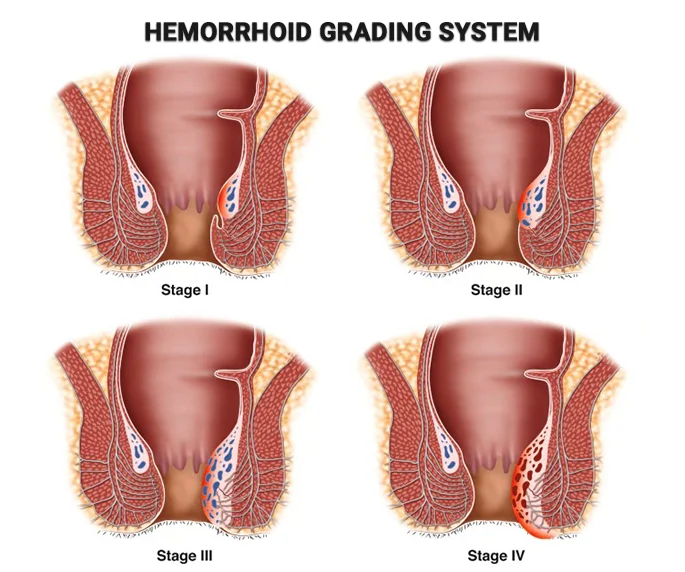
The severity of hemorrhoidal disease is classified based on the progression and degree of prolapse of the hemorrhoidal tissue:
Grade I: Hemorrhoids remain entirely within the anal canal
Grade II: Hemorrhoids prolapse during defecation but spontaneously reduce afterward
Grade III: Hemorrhoids prolapse during defecation or physical activity and require manual reduction or reduce when lying down
Grade IV: Hemorrhoids are persistently prolapsed and remain outside the anal canal
What are prolapsed hemorrhoids?
Prolapsed hemorrhoids refer to the condition in which hemorrhoidal tissue protrudes outside the anal canal, typically occurring during defecation or physical exertion. The degree of prolapse depends on the stage of the disease. In mild cases, patients may experience minimal discomfort or a sensation of fullness. In more advanced stages, the prolapsed hemorrhoids become larger and more prominent, causing significant pain during defecation and negatively affecting psychological well-being and quality of life.
Hemorrhoidal prolapse commonly appears from grade II onward and may occur in internal, external, or mixed hemorrhoids. Internal hemorrhoids develop above the dentate line within the anal canal, while external hemorrhoids arise below the dentate line. Mixed hemorrhoids involve both internal and external components that may become interconnected.
Prolapsed hemorrhoids can lead to serious complications if left untreated, including venous thrombosis, tissue necrosis, chronic blood loss, and systemic infection (sepsis).
Can prolapsed hemorrhoids be manually reduced?
Many patients attempt to manually push prolapsed hemorrhoids back into the anal canal to relieve discomfort during daily activities. This approach may be applicable in mild cases, where the hemorrhoids are still reducible, not significantly swollen, and not associated with pain or bleeding. However, this maneuver only provides temporary symptomatic relief and does not treat the underlying condition. Proper hand hygiene is essential to minimize the risk of infection.
In more advanced stages, manual reduction may worsen the condition and increase the risk of complications. Therefore, patients are advised to seek evaluation and management at a medical facility for appropriate treatment and monitoring, rather than relying on self-management.
Inflamed hemorrhoids with purulent discharge
Hemorrhoids with purulent discharge indicate inflammation of the hemorrhoidal tissue accompanied by the presence of pus (typically whitish). If not treated promptly, this condition may progress to severe ulceration or tissue necrosis, with the potential for necrosis to extend to surrounding perianal tissues.
At this stage, patients often experience significant pain, markedly affecting daily activities such as walking, sitting, and overall functional capacity.
The presence of pus within hemorrhoidal tissue suggests advanced disease progression. Therefore, early medical intervention is essential to prevent serious complications and ensure appropriate management.
Management of prolapsed hemorrhoids
Currently, a variety of treatment options are available for prolapsed hemorrhoids. In mild cases, patients may initiate conservative self-care measures at home, including increasing dietary fiber intake, maintaining adequate hydration, weight reduction in overweight individuals, and avoiding behaviors that increase intra-rectal pressure such as prolonged sitting or excessive straining during defecation.
If conservative measures are ineffective, or if prolapsed hemorrhoids are associated with persistent bleeding and pain, medical intervention is required based on specialist evaluation. Treatment options may include pharmacological therapy, minimally invasive procedures, or surgical intervention.
Depending on the classification and severity of the condition, physicians may recommend:
Pharmacological therapy: Topical or oral medications, or a combination of both, aimed at reducing inflammation, controlling symptoms, and promoting shrinkage of hemorrhoidal tissue
Minimally invasive procedures: Tailored to individual patient conditions, including sclerotherapy, rubber band ligation, thermal coagulation, infrared coagulation, or laser treatment
Appropriate and timely intervention is essential to relieve symptoms, prevent complications, and improve quality of life.
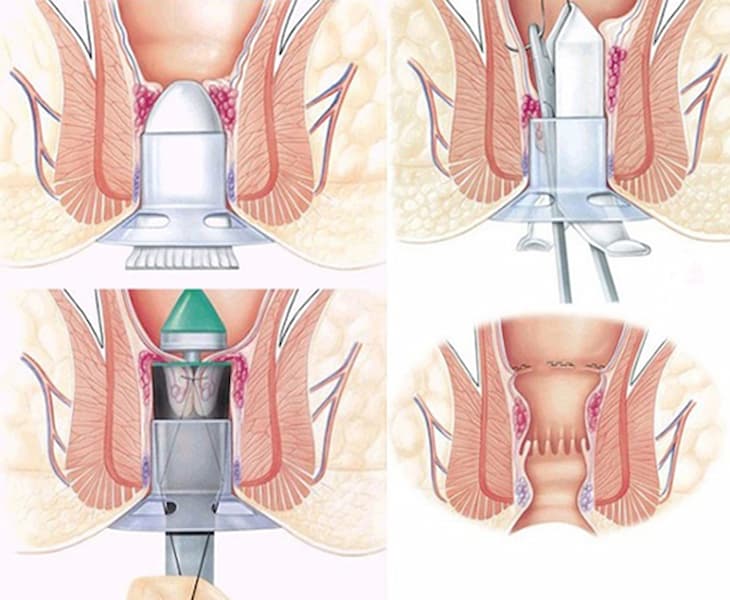
Illustration of the Longo procedure (stapled hemorrhoidopexy)
Surgical management: Surgery is typically indicated for patients with advanced prolapsed hemorrhoids that do not respond to conservative or minimally invasive treatments. Common surgical techniques currently performed at many healthcare facilities include:
Conventional hemorrhoidectomy using open techniques, including plasma blade-assisted excision
These approaches aim to effectively remove or reduce hemorrhoidal tissue, restore normal anatomy, and minimize the risk of recurrence.
All of the aforementioned hemorrhoid treatment methods have their own advantages and limitations. To determine the most appropriate management for prolapsed hemorrhoids, patients should undergo evaluation by a specialist to accurately assess disease severity and select a suitable treatment approach.
Hong Ngoc General Hospital is a reputable healthcare facility widely trusted by patients for the treatment of hemorrhoidal disease. The hospital is equipped with modern medical technology, including advanced DST hemorrhoid surgery systems from the United States, along with sterile operating rooms that ensure patient safety and optimal surgical outcomes.
Notably, patients are directly examined and consulted by a highly experienced surgical team, including:
Prof. Nguyen Xuan Hung, MD, PhD, People’s Physician – one of Vietnam’s leading experts in gastrointestinal surgery and anorectal diseases; former Director of the Colorectal and Pelvic Floor Surgery Center, former Head of the Department of Gastrointestinal Surgery, and former Head of the Outpatient Department at Viet Duc University Hospital; Vice President of the Vietnam Society of Colorectal and Anal Diseases; member of the Vietnam Society of Surgery and Endoscopic Surgery; and member of the French Society for the Treatment of Colorectal and Anal Diseases
Nguyen Giang Lam, MD, MSc, Specialist Level II
Do Van Toa, MD, Specialist Level II
Based on comprehensive evaluation, the medical team will provide individualized treatment plans to ensure optimal clinical outcomes while maintaining cost-effectiveness for patients.
Patients with prolapsed hemorrhoids can place full confidence in the expertise of the surgical team at Hong Ngoc General Hospital.
For further consultation, please contact:
Hotline for appointments with Prof. Nguyen Xuan Hung: (+84) 911 908 856
Hotline for hemorrhoid surgery consultation: (+84) 949 646 556
Register to receive information and consultation at:
Note: The information provided in this article by Hong Ngoc General Hospital is for reference purposes only and does not replace professional medical diagnosis or treatment. Patients are advised not to self-medicate. For an accurate diagnosis and appropriate treatment plan, individuals should seek direct evaluation by qualified physicians at medical facilities.
Follow the official fanpage of Hong Ngoc General Hospital for more useful health information and special programs.
Prolapsed hemorrhoids, where patients can palpate a protruding mass, are among the most common clinical signs of hemorrhoidal disease. If not treated promptly, this condition may lead to serious complications such as venous thrombosis, strangulated hemorrhoids, tissue necrosis, and even sepsis.
To better understand prolapsed hemorrhoids, you may refer to the following information:
What are hemorrhoids? What are hemorrhoidal cushions?
Hemorrhoids are a common anorectal condition that occurs when increased intra-abdominal pressure leads to impaired venous return in the anal region. As a result, blood pools within the hemorrhoidal veins, causing them to become dilated, swollen, and engorged over time, forming what are known as hemorrhoidal cushions.
Grades of hemorrhoidal disease
Hemorrhoidal disease is classified into two main types: internal hemorrhoids and external hemorrhoids:
External hemorrhoids: Occur below the dentate line (anorectal junction) and are covered by stratified squamous epithelium, located beneath the perianal skin
Internal hemorrhoids: Develop above the dentate line and are covered by rectal mucosa and transitional epithelium
The severity of hemorrhoidal disease is classified based on the progression and degree of prolapse of the hemorrhoidal tissue:
Grade I: Hemorrhoids remain entirely within the anal canal
Grade II: Hemorrhoids prolapse during defecation but spontaneously reduce afterward
Grade III: Hemorrhoids prolapse during defecation or physical activity and require manual reduction or reduce when lying down
Grade IV: Hemorrhoids are persistently prolapsed and remain outside the anal canal
What are prolapsed hemorrhoids?
Prolapsed hemorrhoids refer to the condition in which hemorrhoidal tissue protrudes outside the anal canal, typically occurring during defecation or physical exertion. The degree of prolapse depends on the stage of the disease. In mild cases, patients may experience minimal discomfort or a sensation of fullness. In more advanced stages, the prolapsed hemorrhoids become larger and more prominent, causing significant pain during defecation and negatively affecting psychological well-being and quality of life.
Hemorrhoidal prolapse commonly appears from grade II onward and may occur in internal, external, or mixed hemorrhoids. Internal hemorrhoids develop above the dentate line within the anal canal, while external hemorrhoids arise below the dentate line. Mixed hemorrhoids involve both internal and external components that may become interconnected.
Prolapsed hemorrhoids can lead to serious complications if left untreated, including venous thrombosis, tissue necrosis, chronic blood loss, and systemic infection (sepsis).
Can prolapsed hemorrhoids be manually reduced?
Many patients attempt to manually push prolapsed hemorrhoids back into the anal canal to relieve discomfort during daily activities. This approach may be applicable in mild cases, where the hemorrhoids are still reducible, not significantly swollen, and not associated with pain or bleeding. However, this maneuver only provides temporary symptomatic relief and does not treat the underlying condition. Proper hand hygiene is essential to minimize the risk of infection.
In more advanced stages, manual reduction may worsen the condition and increase the risk of complications. Therefore, patients are advised to seek evaluation and management at a medical facility for appropriate treatment and monitoring, rather than relying on self-management.
Inflamed hemorrhoids with purulent discharge
Hemorrhoids with purulent discharge indicate inflammation of the hemorrhoidal tissue accompanied by the presence of pus (typically whitish). If not treated promptly, this condition may progress to severe ulceration or tissue necrosis, with the potential for necrosis to extend to surrounding perianal tissues.
At this stage, patients often experience significant pain, markedly affecting daily activities such as walking, sitting, and overall functional capacity.
The presence of pus within hemorrhoidal tissue suggests advanced disease progression. Therefore, early medical intervention is essential to prevent serious complications and ensure appropriate management.
Management of prolapsed hemorrhoids
Currently, a variety of treatment options are available for prolapsed hemorrhoids. In mild cases, patients may initiate conservative self-care measures at home, including increasing dietary fiber intake, maintaining adequate hydration, weight reduction in overweight individuals, and avoiding behaviors that increase intra-rectal pressure such as prolonged sitting or excessive straining during defecation.
If conservative measures are ineffective, or if prolapsed hemorrhoids are associated with persistent bleeding and pain, medical intervention is required based on specialist evaluation. Treatment options may include pharmacological therapy, minimally invasive procedures, or surgical intervention.
Depending on the classification and severity of the condition, physicians may recommend:
Pharmacological therapy: Topical or oral medications, or a combination of both, aimed at reducing inflammation, controlling symptoms, and promoting shrinkage of hemorrhoidal tissue
Minimally invasive procedures: Tailored to individual patient conditions, including sclerotherapy, rubber band ligation, thermal coagulation, infrared coagulation, or laser treatment
Appropriate and timely intervention is essential to relieve symptoms, prevent complications, and improve quality of life.
Illustration of the Longo procedure (stapled hemorrhoidopexy)
Surgical management: Surgery is typically indicated for patients with advanced prolapsed hemorrhoids that do not respond to conservative or minimally invasive treatments. Common surgical techniques currently performed at many healthcare facilities include:
Conventional hemorrhoidectomy using open techniques, including plasma blade-assisted excision
These approaches aim to effectively remove or reduce hemorrhoidal tissue, restore normal anatomy, and minimize the risk of recurrence.
All of the aforementioned hemorrhoid treatment methods have their own advantages and limitations. To determine the most appropriate management for prolapsed hemorrhoids, patients should undergo evaluation by a specialist to accurately assess disease severity and select a suitable treatment approach.
Hong Ngoc General Hospital is a reputable healthcare facility widely trusted by patients for the treatment of hemorrhoidal disease. The hospital is equipped with modern medical technology, including advanced DST hemorrhoid surgery systems from the United States, along with sterile operating rooms that ensure patient safety and optimal surgical outcomes.
Notably, patients are directly examined and consulted by a highly experienced surgical team, including:
Prof. Nguyen Xuan Hung, MD, PhD, People’s Physician – one of Vietnam’s leading experts in gastrointestinal surgery and anorectal diseases; former Director of the Colorectal and Pelvic Floor Surgery Center, former Head of the Department of Gastrointestinal Surgery, and former Head of the Outpatient Department at Viet Duc University Hospital; Vice President of the Vietnam Society of Colorectal and Anal Diseases; member of the Vietnam Society of Surgery and Endoscopic Surgery; and member of the French Society for the Treatment of Colorectal and Anal Diseases
Nguyen Giang Lam, MD, MSc, Specialist Level II
Do Van Toa, MD, Specialist Level II
Based on comprehensive evaluation, the medical team will provide individualized treatment plans to ensure optimal clinical outcomes while maintaining cost-effectiveness for patients.
Patients with prolapsed hemorrhoids can place full confidence in the expertise of the surgical team at Hong Ngoc General Hospital.
For further consultation, please contact:
Hotline for appointments with Prof. Nguyen Xuan Hung: (+84) 911 908 856
Hotline for hemorrhoid surgery consultation: (+84) 949 646 556
Register to receive information and consultation at:
Note: The information provided in this article by Hong Ngoc General Hospital is for reference purposes only and does not replace professional medical diagnosis or treatment. Patients are advised not to self-medicate. For an accurate diagnosis and appropriate treatment plan, individuals should seek direct evaluation by qualified physicians at medical facilities.
Follow the official fanpage of Hong Ngoc General Hospital for more useful health information and special programs.
Để lại câu hỏi của bạn để nhận được giải đáp từ các bác sĩ của Hồng Ngọc
Lorem ipsum dolor
Lorem ipsum dolor sit amet, consectetur adipiscing elit. Mauris odio lectus, pretium faucibus nisi eu, accumsan consectetur orci. In blandit vehicula nisl, vel lacinia ligula finibus a. Donec fermentum rhoncus