



Cholesteatoma otitis can cause severe ear pain and, in some cases, sudden hearing loss, leaving patients anxious and distressed. So, what exactly is cholesteatoma, and what are the effective treatment methods commonly used today?
What is cholesteatoma?
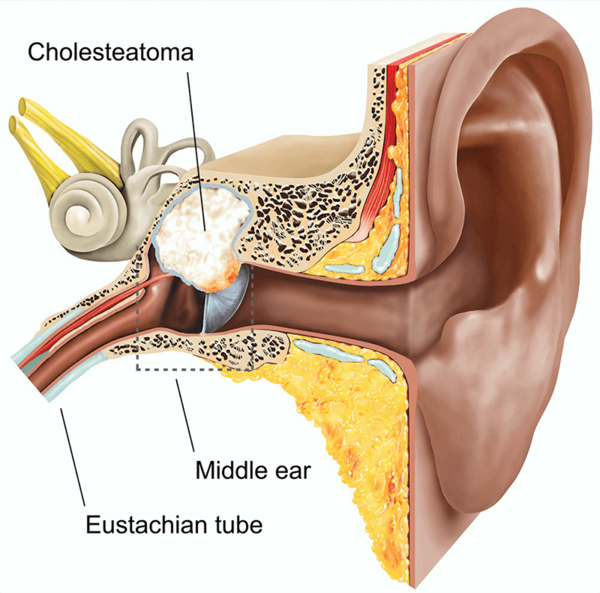
Cholesteatoma is a condition in which dead skin cells (keratin debris) accumulate and form a keratinized mass within the middle ear or mastoid bone. Although it is a form of chronic otitis media, cholesteatoma is not a cancer, and it does not contain cholesterol or fat. The condition usually develops from two main causes:
- Primary cholesteatoma: caused by dysfunction of the eustachian tube (the canal connecting the middle ear to the nasopharynx), leading to negative pressure in the middle ear. Over time, this pressure causes retraction of the eardrum, creating a pocket where dead cells accumulate and gradually form a cholesteatoma, obstructing normal ventilation of the ear.
- Secondary cholesteatoma: occurs after a perforation of the eardrum. The opening allows squamous epithelium to migrate into the middle ear, where it builds up and forms a keratinized mass.
Is cholesteatoma dangerous?
In its early stages, cholesteatoma may not cause noticeable symptoms and does not appear to pose a high risk. However, if left undetected and untreated, it can progress to severe complications. Potential risks include:
- Hearing loss: the cholesteatoma can damage the delicate structures of the middle and inner ear, leading to partial or complete hearing loss.
- Recurrent infections: the keratinized mass creates a favorable environment for bacterial growth, resulting in repeated ear infections. Patients may experience ear pain, swelling, persistent discharge, and tinnitus.
- Neurological and mastoid complications: as the cholesteatoma enlarges, it may erode into vital structures such as the mastoid bone and even affect nearby nerves, causing neurological problems and increasing the risk of life-threatening intracranial infections.
What are the symptoms of cholesteatoma?
In the early stages, cholesteatoma often does not cause clear symptoms. Over time, however, patients may begin to notice signs such as persistent ear discharge, itching inside the ear, or mild ear pain. These symptoms are easily mistaken for common ear problems, which is why it is important to undergo timely evaluation by an otolaryngology specialist if any abnormalities are present.
In the progressive stage, as the mass enlarges, its impact on ear health and hearing becomes more evident. Patients may experience sudden episodes of dizziness, acute ear pain, and noticeable hearing loss. These symptoms can appear and disappear intermittently, significantly affecting quality of life.
Reader may also be interested in:
In the advanced stage, if left untreated, the eardrum and inner ear are placed under extreme pressure, resulting in severe pain and potentially complete hearing loss.

Diagnosis of cholesteatoma
Primary cholesteatoma is often more difficult to detect in its early stages and requires specialized diagnostic methods, such as:
- Otoscopy under a microscope: to detect epithelial debris accumulation behind the eardrum.
- Temporal bone CT scan: to evaluate the extent and severity of the disease.
- MRI: indicated in cases where intracranial complications are suspected.
For an accurate assessment of your ear health, it is essential to visit a reputable medical facility for thorough examination and expert consultation with experienced otolaryngologists.
To schedule an appointment with our ENT specialists, please contact our hotline: 091.2002.131 – 0949.646.556 or register HERE.
How is cholesteatoma treated?
Drainage of ear discharge and pus combined with medical therapy
- Drainage: removing accumulated fluid and pus from the middle ear is an immediate intervention that helps clean the ear, reduce bacterial load, and temporarily control infection. This procedure also helps relieve symptoms such as ear pain and tinnitus.
- Medical treatment: oral antibiotics may be prescribed in cases of severe infection or high risk of complications. Anti-inflammatory and analgesic medications can also be used to control symptoms and improve the patient’s quality of life.
However, it is important to emphasize that medical management alone cannot cure cholesteatoma. These measures are supportive and temporary, often applied before or in combination with surgical treatment.

Removal of the cholesteatoma mass: this is the critical step in treatment. The surgeon carefully creates access to the middle ear and mastoid, meticulously excising the entire cholesteatoma while preserving surrounding anatomical structures. This requires high precision to ensure complete eradication and to protect vital ear components such as the ossicles, facial nerve, and inner ear.
- Tympanoplasty (eardrum reconstruction): after the cholesteatoma has been removed, reconstruction of the tympanic membrane is performed to restore hearing. The most advanced techniques today utilize autologous grafts (such as cartilage or temporalis fascia) or homologous grafts, which enhance compatibility, promote healing, and improve long-term hearing outcomes.
Surgical treatment
Surgery is considered the most effective and irreplaceable method for managing cholesteatoma. The primary goals are to completely remove the cholesteatoma mass and reconstruct the eardrum, thereby restoring hearing and preventing recurrence. Surgical indication depends on the disease status, ear canal function, and the size of the mastoid air cells.
- Removal of the cholesteatoma mass: this is the critical step in treatment. The surgeon carefully creates access to the middle ear and mastoid, meticulously excising the entire cholesteatoma while preserving surrounding anatomical structures. This requires high precision to ensure complete eradication and to protect vital ear components such as the ossicles, facial nerve, and inner ear.
- Tympanoplasty (eardrum reconstruction): after the cholesteatoma has been removed, reconstruction of the tympanic membrane is performed to restore hearing. The most advanced techniques today utilize autologous grafts (such as cartilage or temporalis fascia) or homologous grafts, which enhance compatibility, promote healing, and improve long-term hearing outcomes.

Hong Ngoc General Hospital is currently utilizing the most modern technologies and techniques in the management of cholesteatoma. In particular, the adoption of next-generation surgical microscopes allows for an expanded field of vision inside the ear cavity. This enables surgeons to thoroughly remove the lesion while minimizing the risk of damage to the ossicular chain and surrounding anatomical structures.
CONTACT INFORMATION
DEPARTMENT OF OTORHINOLARYNGOLOGY – HONG NGOC GENERAL HOSPITAL
- Addresses: 8 Chau Van Liem, Nam Tu Liem, Hanoi 55 Yen Ninh, Ba Dinh, Hanoi
- Hotline: 091.2002.131 – 0949.646.556
Note: The information provided in this article by Hong Ngoc General Hospital is for reference only and does not replace medical diagnosis or treatment. To accurately assess your condition, please visit a reputable healthcare facility for direct examination and consultation with a qualified physician.
Enhance your knowledge of ear, nose, and throat diseases by following the official fanpage of the Department of Otorhinolaryngology & Head and Neck Surgery – Hong Ngoc General Hospital.