


Esophageal cancer is one of the most dangerous malignancies of the digestive system, ranking just after stomach, liver, and colorectal cancer, mainly because it is often diagnosed at a late stage. Therefore, early recognition of esophageal cancer symptoms is crucial for improving treatment outcomes and prognosis.
Overview of esophageal cancer
What is esophageal cancer? Esophageal cancer is a malignancy that occurs when the epithelial cells lining the esophagus grow uncontrollably, forming a malignant tumor. The disease progresses through several stages — from small localized tumors in the esophagus to invasion of nearby structures or distant metastasis to other organs.
Stages of esophageal cancer
The disease is classified into four stages based on its level of progression:
Stage 1: This is the earliest stage, when cancer cells have just formed and are confined to the outermost layer of the esophageal wall. Stage 2: At this stage, cancer cells have invaded nearby lymphatic tissues but have not yet spread to other organs. Stage 3: Cancer cells have penetrated deeper layers of the esophageal wall and spread to surrounding tissues and lymph nodes near the esophagus. Stage 4: This is the final stage, when cancer cells have metastasized to distant organs such as the liver, lungs, or brain.
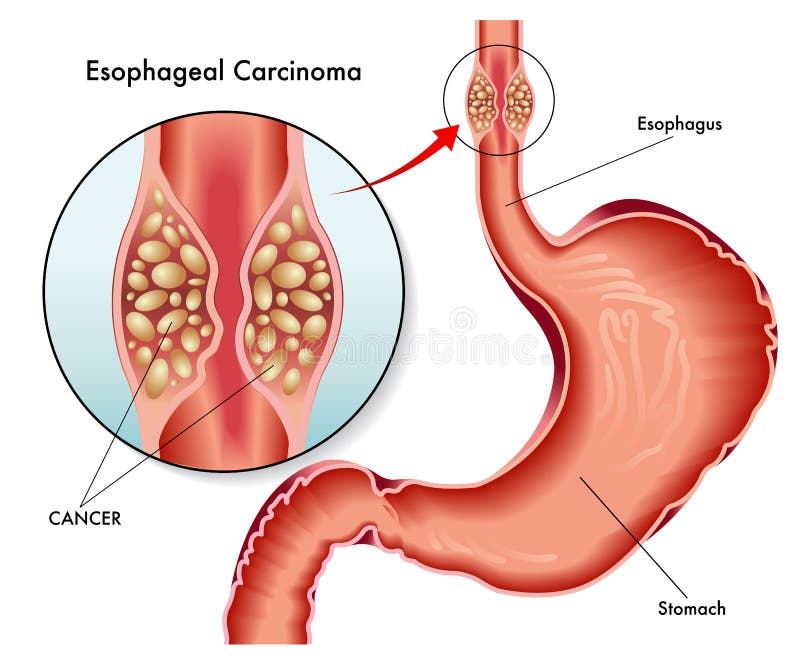
Types of esophageal cancer
There are two main types of esophageal cancer, classified based on the cells from which the tumor originates:
Squamous cell carcinoma: This type develops from the squamous cells lining the inner surface of the esophagus. It most commonly occurs in the upper and middle portions of the esophagus.Adenocarcinoma: This type arises from glandular cells that produce mucus in the lower portion of the esophagus. It is more common in individuals with gastroesophageal reflux disease (GERD) or Barrett’s esophagus.Less common types include lymphoma, sarcoma, and metastatic tumors originating from other organs.
Causes of esophageal cancer
The exact cause of esophageal cancer remains unclear; however, several risk factors have been identified that increase the likelihood of developing the disease, including:
- Lifestyle factors: Smoking, excessive alcohol consumption, a diet low in fruits and vegetables, and frequent intake of very hot food or beverages.
- Underlying medical conditions: Gastroesophageal reflux disease (GERD), Barrett’s esophagus (mucosal damage caused by acid reflux), Plummer–Vinson syndrome, and obesity.
- Other factors: Advanced age, genetic predisposition, exposure to certain chemicals, and a history of chest radiotherapy.

Symptoms of esophageal cancer
In the early stages, esophageal cancer often causes no noticeable symptoms. As cancer cells grow and the disease progresses, the following symptoms may appear:
- Difficulty swallowing (dysphagia): The most common symptom—initially, patients have trouble swallowing solid foods, which later progresses to difficulty with liquids and even saliva.
- Unexplained weight loss: Rapid, unintended weight loss is a key warning sign of esophageal cancer.
- Chest pain or discomfort: A feeling of pain or pressure behind the sternum that may radiate to the back or shoulder blades.
- Vomiting: Patients may regurgitate recently eaten food that has not yet passed into the stomach.
- Other symptoms: Excessive salivation, bad breath, belching, choking while eating or drinking, persistent cough, hoarseness, nausea, vomiting, or coughing up blood.

Diagnosis and treatment of esophageal cancer
Diagnosis of esophageal cancer
Esophageal cancer is diagnosed through endoscopy and tumor biopsy, combined with imaging techniques such as X-ray, CT, PET/CT, and endoscopic ultrasound to determine the stage of the disease.
Clinical examination and symptoms: Common findings include difficulty swallowing (dysphagia), unexplained weight loss, chest pain behind the sternum, and vomiting.Esophagogastroduodenoscopy (EGD): The key diagnostic method that allows direct visualization of the tumor, assessment of its location and morphology, and tissue sampling for biopsy.Biopsy and histopathological analysis: The collected tissue sample is examined under a microscope to confirm the presence and type of cancer cells.
Imaging diagnosis:
- Barium swallow X-ray: Helps detect abnormal changes in the shape or contour of the esophagus.
- Computed tomography (CT scan): Assesses tumor size, depth of invasion, and possible metastasis to other organs.
- Endoscopic ultrasound (EUS): Provides detailed images showing the extent of tumor invasion into the deeper layers of the esophageal wall and nearby lymph nodes.
Hong Ngoc General Hospital has adopted the state-of-the-art NBI EXTRA III endoscopy system from Japan for gastrointestinal screening. Utilizing Narrow Band Imaging (NBI) technology and an advanced image processing system, NBI EXTRA III enables the early detection of abnormal lesions, particularly early-stage esophageal cancer. When combined with other modern imaging techniques, this technology provides exceptional diagnostic accuracy and supports timely, effective treatment planning.
In particular, the experienced endoscopy team at Hong Ngoc General Hospital is capable of performing minimally invasive interventions to remove early cancerous lesions during endoscopy. This approach allows patients to receive effective treatment at an early stage, significantly reducing the need for complex surgical procedures and improving overall outcomes.
Contact the hotline: 0911 908 856 for detailed consultation.

Treatment of esophageal cancer
Depending on the stage of the disease, tumor progression, and the patient’s overall health condition, specialists will recommend the most appropriate treatment approach for each individual case.
- Endoscopic treatment: For early-stage esophageal cancer without metastasis, doctors may perform endoscopic submucosal dissection (ESD). This is a minimally invasive technique that allows for quick recovery and can achieve a complete cure if the cancer is detected early.
- Surgery: The primary treatment method, especially in the early stages, involves removing the tumor along with part of the esophagus and nearby lymph nodes, followed by esophageal reconstruction.
- Chemotherapy: Uses anticancer drugs, administered intravenously or orally, to destroy cancer cells and prevent their growth. Chemotherapy is usually given in cycles and may be combined with other treatments.
- Radiotherapy: Employs high-energy X-rays to destroy cancer cells. It can be performed as external beam radiation or brachytherapy (placing a radioactive source near the tumor).
- Palliative care: For advanced-stage patients, palliative treatment focuses on pain relief
Stages | Key characteristics | Treatment methods | Prognosis |
1 | A small tumor confined to the mucosal layer of the esophagus. | Endoscopic surgery and treatment | Favorable |
2 | The tumor has invaded deeper tissues, spread into the esophageal wall, and may have metastasized to nearby lymph nodes. | Surgery combined with chemotherapy or radiation therapy | Moderate |
3 | The tumor has invaded deep tissue layers, metastasized to multiple lymph nodes, and may have spread to adjacent organs. | Combination therapy with surgery, chemotherapy, and radiation therapy | Poor |
4 | The tumor has metastasized to distant organs such as the liver, lungs, bones, and stomach. | Palliative care: Focused on pain relief and improving quality of life. | Very poor. |
Table: Stages of esophageal cancer and corresponding treatment approaches
Preventive measures for esophageal cancer
There is currently no absolute method to prevent esophageal cancer. However, you can reduce your risk by adopting a healthy lifestyle and eliminating potential risk factors.
Do not smoke: Tobacco use is one of the leading causes of esophageal cancer, particularly squamous cell carcinoma. Quitting smoking or avoiding tobacco altogether can significantly reduce the risk of developing the disease.
Limit alcohol consumption: Long-term and excessive intake of alcohol can damage the mucosal lining of the esophagus and stomach, thereby increasing the risk of cancer. Reducing or eliminating alcohol consumption is an effective way to protect overall health.
Maintain a healthy diet: Increase intake of fiber, vitamins, and antioxidants by consuming more green vegetables, fresh fruits, whole grains, green tea, and protein-rich foods. Limit greasy, spicy, processed, pickled, or fermented foods to protect the esophageal mucosa.
Adopt a healthy lifestyle: Avoid overworking, manage stress, and ensure adequate rest. Chronic stress can negatively affect the digestive system and increase the risk of esophageal disorders.
Treat related medical conditions: If you have gastroesophageal reflux disease (GERD), achalasia, or other esophageal disorders, follow the prescribed treatment plan and attend regular check-ups to prevent complications.
Undergo regular screening: Esophageal cancer can be detected early through gastrointestinal endoscopy. Individuals at high risk — such as those with a history of esophagitis or head and neck cancers — should undergo routine screening for timely detection and treatment.
Early screening and detection of esophageal cancer enable highly effective treatment and allow for the removal of precancerous lesions during endoscopy without the need for surgery.
At Hong Ngoc General Hospital, patients undergoing early screening for esophageal cancer will be directly examined, endoscopically assessed, and treated by a team of highly qualified gastroenterology specialists, including: Assoc. Prof. Dr. Nguyen Canh Binh – Gastroenterology expert with over 35 years of experience, Dr. Dang Thi Kim Oanh, MD, PhD (Specialist Level II), MSc. Dr. Le Thi Van Anh, MSc. Dr. Nguyen Hai Anh, Dr. Nguyen Tien Son, MSc. Dr. Le Duong Tien,...
Contact Hotline: 0911 908 856 for detailed consultation.
Frequently asked questions about esophageal cancer
How long can a person with esophageal cancer live?
The survival time of a patient with esophageal cancer largely depends on the stage at which the disease is diagnosed. If detected early, the 5-year survival rate can reach 70–90%. However, once the disease progresses to an advanced stage (stage IV), the 5-year survival rate drops significantly to below 5–10%.
What foods should be avoided in esophageal cancer?
Patients with esophageal cancer should avoid hard, dry, spicy, or hot foods, as well as processed foods high in preservatives such as smoked meats, sausages, fried foods, sweets, alcoholic and carbonated beverages, and raw, undercooked, or moldy foods. These can cause irritation, digestive discomfort, and increase the risk of infection.
Can esophageal cancer be cured?
Esophageal cancer tends to progress rapidly, and in most cases, it is diagnosed only at an advanced stage, making treatment more complex and costly. However, when detected early, the success rate of treatment is significantly higher, offering patients a much better chance of recovery and long-term survival.
Note: The information provided in this article by Hong Ngoc General Hospital is for reference purposes only and should not replace professional medical diagnosis or treatment. Patients are advised not to self-medicate. To accurately determine their medical condition, patients should visit a hospital for direct examination, diagnosis, and consultation with a physician to receive the most appropriate and effective treatment plan and prescription. Gastroenterology Center – Hong Ngoc General Hospital
Hotline: 0911 908 856 – 0932 232 016Email: trungtamtieuhoa@hongngochospital.vn Follow for more useful information and special offers: https://www.facebook.com/trungtamtieuhoaBVHongNgoc |