

At the scientific conference “Artificial Intelligence in Vietnamese Healthcare 2026: From Vision to Real-World Impact” (AI4HEALTH 2026), Hong Ngoc General Hospital participated not only as a Gold Sponsor but also contributed practical insights through a scientific presentation on the application of artificial intelligence in diagnosis and treatment.
Worldwide, artificial intelligence (AI) is emerging as an important technological solution shaping the future of healthcare. Its applications continue to expand across multiple areas, from supporting the interpretation of X-rays, CT scans, MRI scans and ultrasound images for the early detection of abnormalities to personalising treatment plans and optimising hospital management. As healthcare systems face increasing pressure, big-data analytics and AI tools are expected to help shorten diagnostic timelines and reduce the workload of healthcare professionals.
In Vietnam, the adoption of AI is progressing from theoretical research towards pilot implementation and evaluation in clinical practice. This transition requires close collaboration among regulatory authorities, research institutions and healthcare providers to establish appropriate legal frameworks, data standards and safe operational procedures.
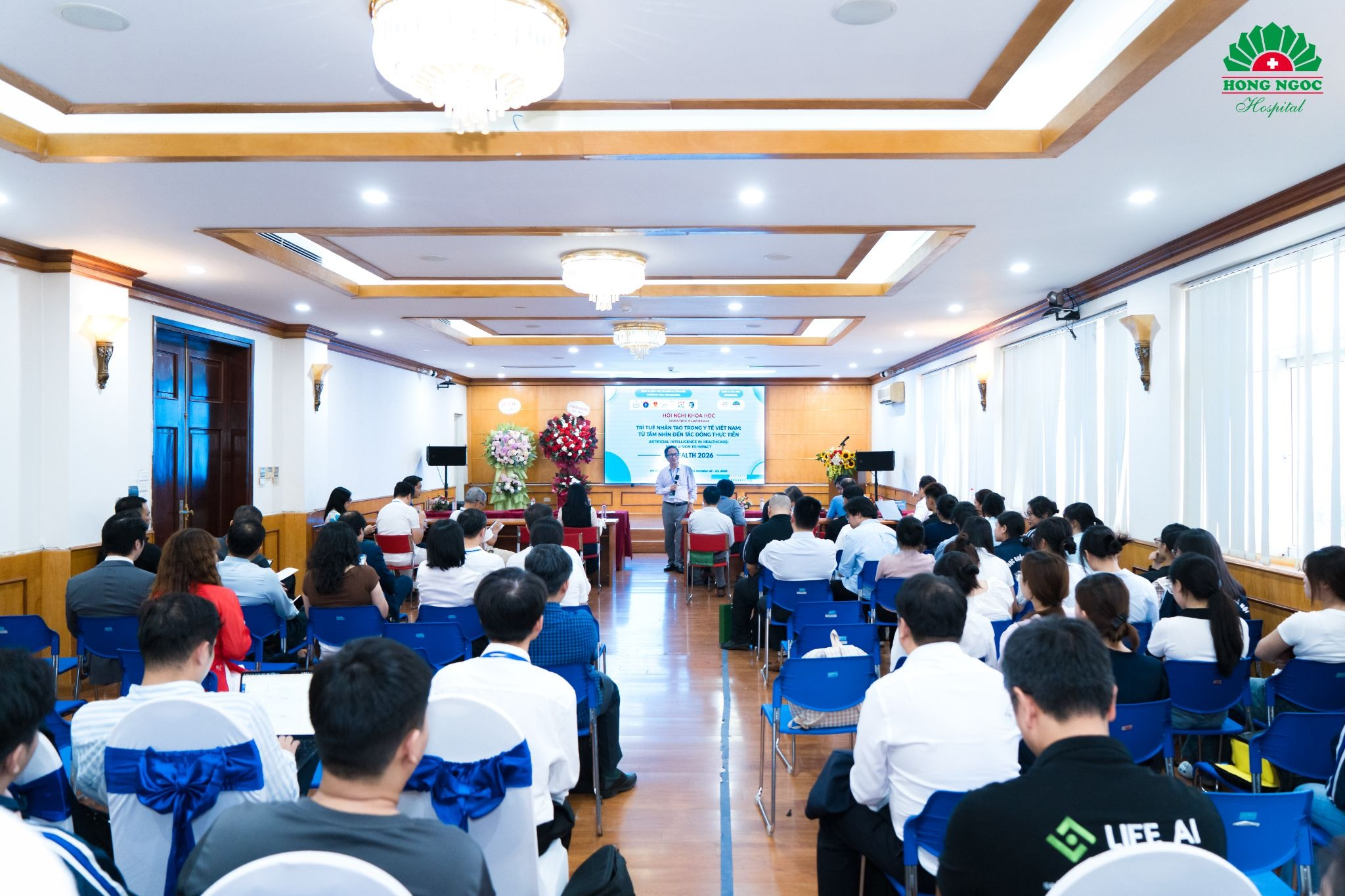
To discuss solutions for accelerating the adoption of technology in healthcare, the scientific conference “Artificial Intelligence in Vietnamese Healthcare 2026: From Vision to Real-World Impact” was held on 23 and 24 October at Vietnam National University, Hanoi. Hosted by the VNU University of Medicine and Pharmacy, the conference brought together more than 300 policymakers, scientists, doctors and technology experts.
The programme featured 48 scientific presentations and 10 poster presentations across 14 specialised thematic areas, including development strategies, data infrastructure, clinical applications, regulatory frameworks, medical ethics and regulatory sandbox mechanisms.
At the event, Hong Ngoc General Hospital participated as both a Gold Sponsor and a scientific contributor, presenting a report on diagnostic imaging approaches to thyroid disorders. Its sponsorship and participation in a national-level scientific forum reflect Hong Ngoc’s commitment to digital transformation and the responsible application of technology in medicine.
For healthcare institutions, early access to emerging policy directions, regulatory frameworks for pilot programmes and the latest research provides an important foundation for modernising infrastructure and improving service quality. Hong Ngoc has gradually integrated artificial intelligence into hospital operations as well as clinical diagnosis and treatment support, delivering practical benefits in everyday clinical practice.
Hong Ngoc’s participation also contributed to strengthening collaboration among research institutes, universities and hospitals, enabling technological solutions to be evaluated and piloted in response to the practical needs of day-to-day healthcare delivery.

Alongside discussions on strategic development, the conference featured several presentations sharing practical experience in implementing technology across specific medical specialties. One example was the presentation on diagnostic imaging approaches to thyroid disorders delivered by Trinh Tu Tam, MD, PhD, Head of the Department of Diagnostic Imaging and Interventional Radiology at Hong Ngoc Phuc Truong Minh General Hospital.
The presentation examined practical aspects of detecting and assessing thyroid lesions using ultrasound. Risk stratification according to the TI-RADS classification system can sometimes be challenging because the distinction between benign and malignant lesions is not always clear, while image interpretation may also be influenced by the operator’s experience and clinical judgement.
The presentation also highlighted how image-analysis software can provide additional objective reference parameters for evaluating thyroid nodules. Such technology can serve as a valuable decision-support tool for clinicians, helping reduce the risk of missed lesions and optimise treatment planning for patients.

The AI4HEALTH 2026 scientific conference provided a comprehensive overview of the current landscape and future prospects for the application of artificial intelligence in Vietnamese healthcare. The event reaffirmed that, despite its rapid development, technology remains a supporting tool whose effectiveness ultimately depends on doctors’ clinical expertise and treatment approach.
Hong Ngoc General Hospital’s participation in the conference further demonstrated its proactive commitment to keeping pace with scientific knowledge and emerging technological trends, with the aim of delivering safe, effective and sustainable healthcare for patients.